

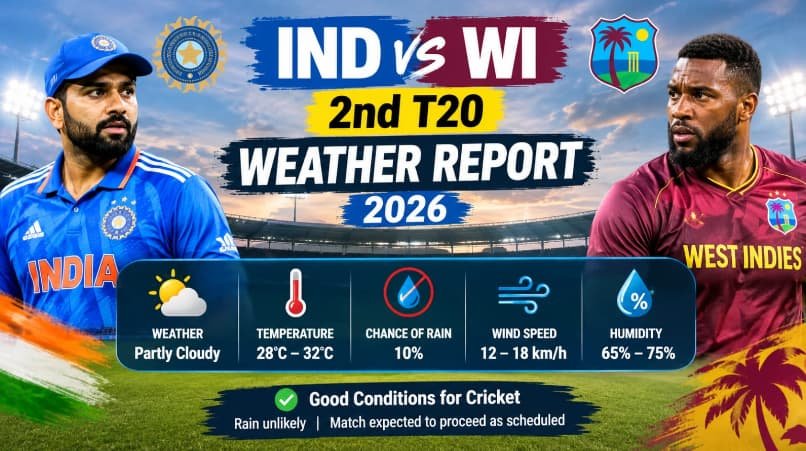
The IND vs WI 2nd T20 Weather Report 2026 matters a lot to cricket viewers. You want to know the rain chance, what the ground might play like, and whether there could be breaks during the second T20I between India and West Indies. In T20 matches, weather can swing things fast. Even a short hold-up can force teams to rethink bowling plans and batting style.
India and West Indies have played some high-energy limited-overs games. India often lean on their batting depth, their spin choices, and their pace unit. West Indies, on the other hand, are famous for hard hitting. They can rack up runs quickly, especially in the middle phase and at the end of the innings. If the second T20I is cloudy, or if rain is expected, both sides may need to tweak their approach.
This write-up brings you the IND vs WI 2nd T20 weather report. It also looks at rain probability, expected conditions, the pitch report, how the toss could matter, live-streaming details, and other key match points.
IND vs WI 2nd T20 Weather Report 2026: Match Overview
Before a T20 match starts, many fans look at the weather. It can affect how batters and bowlers do their job.
You may want to confirm these points:
1) Match: India vs West Indies, 2nd T20 International
2) Tournament: India vs West Indies T20I series 2026
3) Date: Use the official fixture for the day
4) Venue: Confirm the stadium name from the latest update
5) Start time: Check the published match schedule
6) Weather forecast: Look up the newest local report for the venue
7) Rain chance: Check an hour-by-hour update
8) Live score: Watch the official broadcaster or the match centre
The venue and date matter a lot. Conditions can shift from one Indian city to another. So use the forecast for the correct location, not a different city by mistake.
IND vs WI 2nd T20 Rain Chance 2026
People often search for rain chance before a T20 game. Fans want to know if the match can start as planned. They also look for signs that rain may break up an innings. Many also wonder if a full result can still happen.
For the IND vs WI 2nd T20 Weather Report 2026, check the hourly update for the exact ground. Use the forecast for the right day and the real location. If that is not confirmed, any rain figure you see may not be accurate.
Rain is not only about one storm. A few things decide whether play is affected.
- Showers in the afternoon
If rain comes in the afternoon, the team may need more time to ready the field. A quick shower does not always mean the match is over. Grounds staff do the main work after rain stops. They cover key spots and try to make the surface fit to play. Still, steady rain can slow everything down. A wet outfield can also cause delays.
- Rain near the match start
If rain shows up around the toss time, the start can slip. Officials may delay the toss or move the first ball back. How long this takes depends on rain strength, how fast the ground drains, and how the outfield looks.
A short passing shower may only cause a small pause. But steady rain can turn into a bigger delay, especially if there is less time left to finish the game.
- Rain in the second innings
Rain during the chase can change how the match ends. If the game is stopped, the officials may set a new target based on the match rules for the conditions.
In rain-affected limited overs games, the Duckworth-Lewis-Stern, or DLS, method may be used when the rule conditions are met. The new target is based on things like overs left and wickets lost for each team.
For match watchers, overall rain chance alone is not enough. You also need to know when the rain is likely to hit and how long it could last.
IND vs WI 2nd T20 Weather Forecast: Temperature, Humidity and Wind
A match day update is not only about rain. Some other details also shape the mood, like heat, moisture in the air, wind, and the cloud cover around the venue.
Temperature
When it stays warm, batting may feel tougher for long periods. Batters could want extra water during the innings. Fielders might feel more tired as the game goes on.
If the evening turns cooler, the workload can feel lighter for the players. It can also feel better for people in the stands. The exact number will still depend on the pitch area and the start time.
Humidity
Humidity becomes more noticeable in evening T20 matches. If the air is heavy with moisture, players may feel worn out faster. Later, dew can appear, depending on the local conditions.
When dew settles, the ball can become harder to grip. That may slow bowlers as they go for yorkers and late over plans.
Wind Speed
Wind affects how high a catch is judged. It also changes how far and in what way a ball travels through the air. For batters, it can make six hitting easier or harder, based on wind direction and stadium size.
For bowlers, wind can cause small changes in line and length from delivery to delivery. Still, wind alone will not decide the result.
Cloud Cover
Clouds can cut down visibility for batters and fielders. They can also hint at changes in the weather. But clouds do not automatically mean rain.
Fans should review the full weather set, not just one clue.
IND vs WI 2nd T20 Pitch Report 2026
A pitch check matters just as much as the weather. The way the surface plays can tilt how easy or tough it is for batters, and it also affects whether teams want to bat first or bowl first.
Until the venue is officially confirmed, treat any pitch view as a guide only. The final ground details can change how the pitch behaves.
Batting Conditions
A firm and steady wicket can suit batters who like to hit early. In T20, many power hitters try to use the powerplay since the field limits ease after that period.
India can rely on batters who push the run rate up quickly. West Indies often have hitters who can swing the game in a short spell.
If the ball comes off the bat with predictable bounce and the pitch does not move much, teams may reach a solid score. Still, the final total will depend on the ground, the size of the boundaries, the pitch look on the day, and how strong the bowling units are.
Bowling Conditions
Early in the match, a fresh pitch can help fast bowlers. This is more likely if the ball swings in the air or takes off from the surface. When bowlers hit their spots, they can slow runs even when batters go after big shots.
Spinners can matter a lot if the wicket gives grip or some turn. How much they affect the game will depend on the pitch in both innings and the conditions at that time.
Does Rain Affect the Pitch?
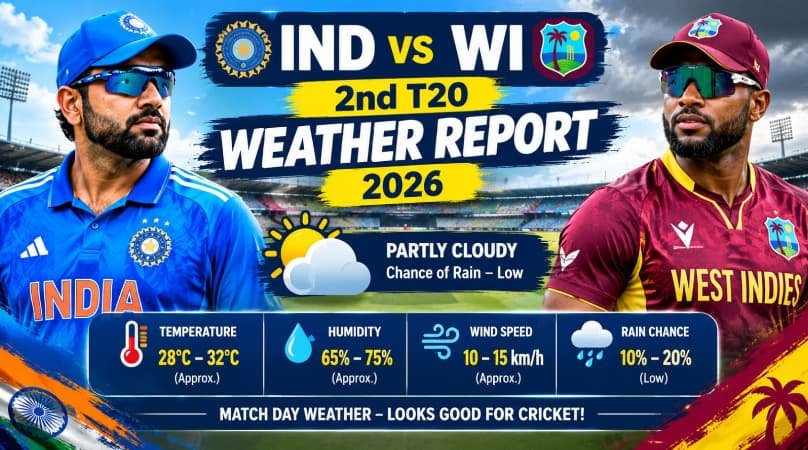
Rain can slow things down before play. It can also make the outfield hold less pace. Wet conditions may change how the ball behaves, but the effect depends on rainfall and how well the ground is covered.
It is better to listen to the ground staff than to assume rain always helps one side.
Will Dew Affect India vs West Indies 2nd T20?
Dew matters in evening T20s. As moisture builds on grass and the ball, both batting and fielding can feel harder.
In the second innings, heavy dew can make it tough for the fielding team to grip the ball. Spinners may lose some control over flight and turn. Fast bowlers may find it harder to land slower balls and yorkers as planned.
Still, dew does not guarantee a win for the chasing team. A tough chase, early setbacks, or tight bowling can flip the outcome.
The toss often carries more weight when dew is expected. Some captains may choose to bowl first so their batters face the later conditions. But the call should also fit the pitch, the weather report, and the squad’s style.
How Rain Could Affect the Match Result
T20 matches have little time to absorb delays. Even a brief pause can cut overs. Longer rain can stop the game from finishing.
There are a few common outcomes.
Scenario 1: Full match
If the sky stays clear and the ground is ready, both teams can play the full scheduled overs. Normal match rules still apply.
Scenario 2: Reduced-overs match
If rain starts late or interrupts play, officials may cut the overs for each team. Captains might adjust the batting order, rethink bowling plans, and change how they pace the chase.
Scenario 3: No result
If the match cannot be finished under the rules for that event, it can be called no-result. The exact conditions depend on the tournament rules and whether there is spare time or other backup plans.
A washout can also shift series positions. If the sides are close, the later matches can end up mattering more.
IND vs WI 2nd T20 Playing XI: What to Watch
The final playing XIs should be confirmed after the toss. Fans should not treat predictions as official picks.
For India, key points are whether the top order stays solid, how quickly the middle overs can be built, spin bowling choices, and whether the fast bowlers can execute at the end.
For West Indies, watch their power hitting, how well they mix right-left batting, the way they vary their bowling, and how their main fast bowlers perform.
If the rain cuts the game short and leaves fewer overs, captains might back hitters who can attack right away. They may also choose bowlers who stay sharp when the pressure is high. The team still has to pick based on who is available, how fit everyone is, what the pitch looks like, and what plan the side wants to follow.
IND vs WI 2nd T20 Live Streaming 2026
If you want to watch IND vs WI in the 2nd T20 in 2026, start by checking the official TV partner and the approved streaming app in your area.
Broadcast rights are not the same everywhere. Different countries may show the match on different services. In India, double check the newest details from the cricket board, the event page, or the broadcaster’s own schedule.
Before match time, confirm these points:
- TV channel name and when coverage begins
- Mobile or web stream that is official
- Live score page and ball by ball commentary
- Updates for rain, plus the toss timing
- Any revised start time shared by the match officials
If rain delays or stops play, rely on the official broadcast feed and the recognised live score source for the latest news on when the game resumes.
IND vs WI Head-to-Head Record in T20 Internationals
India and West Indies have met many times in T20 International cricket. In these games, batting can turn fast. A small change in form can shift the game in a few overs.
India often benefits from batting depth. They also use different bowling styles during the innings. Partnerships matter, and then they speed up when the moment is right.
West Indies can pressure bowlers with power hitting. Their approach is often direct, and they look to take control quickly.
For the most accurate head-to-head numbers, check the latest official stats right before you read or share them. The match count, wins, losses, and any abandoned games can change each time these teams play.
Also, do not treat head-to-head stats as a simple forecast. Venues, team selections, and pitch conditions vary from match to match, so the next result can look very different.
Key Factors That May Shape the 2nd T20I
A few things can swing the result in India vs West Indies.
Toss call: The captains will weigh the pitch look, dew risk, and the most recent forecast. Then they decide to bat or bowl first.
Powerplay start: If wickets fall early, the run rate usually slows. If a team attacks right away, it can seize momentum fast.
Middle overs: Spinners and pace changes matter here. Tight lines and smart variation can slow scoring and force mistakes.
Final overs: Yorkers still matter, as do slower balls and clean catching. Field settings also need to be right during these overs.
Rain and stoppages: If weather turns, the match may lose overs. That can shift the target and change the plan.
Fielding: Errors can decide tight games. A dropped catch, a bad throw, or a missed run-out chance can be costly.
The side that adjusts quickest to what is in front of them may get the edge. Still, the match outcome will come down to how both teams perform.
How to Get the Latest IND vs WI 2nd T20 Weather Update
On match day, check the venue forecast before the toss. Then check again closer to the toss time.
Try to use hourly updates. They are often more helpful than a general weekly view.
Watch for changes in rain timing, temperature, humidity, wind, and any official note on delays. Also pay attention to the ground staff view of the outfield, and to what the umpires decide about when play can start or restart.
Do not spread claims unless they are verified. Forecasts can shift, and they are not the same as an official match update.
Conclusion
The IND vs WI 2nd T20 weather report for 2026 matters for fans who want to know the chance of rain. It also helps explain expected conditions and how dew might play a role.
Weather can affect the toss choice, bowling plans, the number of overs, and whether the target might be revised.
You should also look at the pitch report, the confirmed playing XIs, and the head-to-head record for extra context. Even so, the official venue, match details, and the newest forecast should be checked before you judge what conditions will be like.
Keep checking Cricket Inshight for India vs West Indies match updates. Look for live-streaming info, pitch notes, team news, and more. Use official sources on match day for the latest weather call and any schedule changes.