

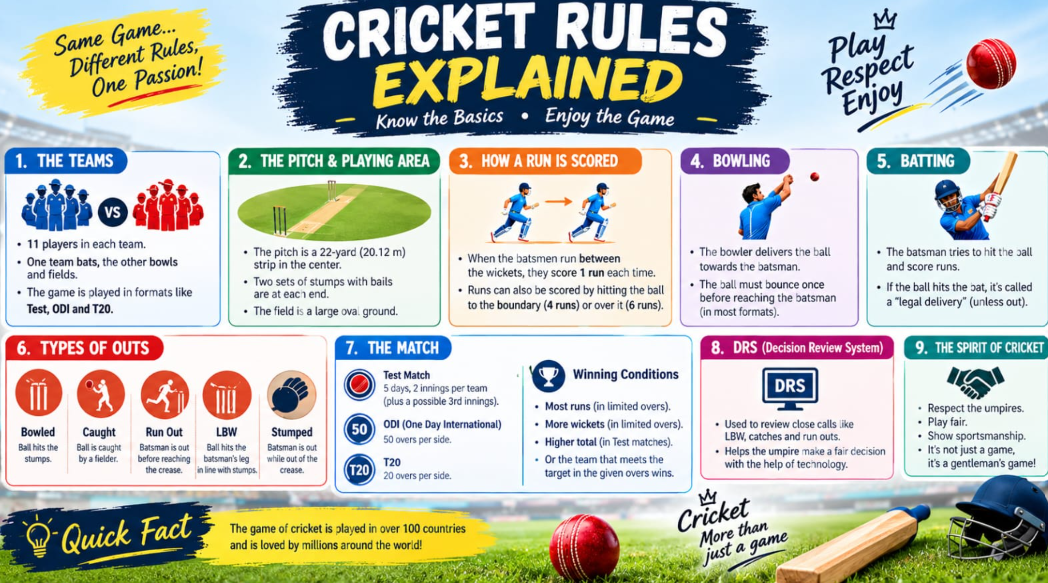
Cricket is a widely watched sport around the globe. People follow games at the international level, in domestic leagues, and in the Indian Premier League. For new viewers, though, the rules can feel hard to follow. Cricket Rules Explained helps beginners understand the game, including terms like LBW, no-ball, wide, free hit, powerplay, and run rate.
If you want to know how cricket works, start with the core rules. Everything in the sport has its own laws, from how runs are added to how wickets are taken. There are also set playing conditions that guide what can happen in a match.
This guide, Cricket Rules Explained, looks at the basic setup of the sport. It also covers how scoring works, key batting and bowling rules, and the common ways a batter can be dismissed. You will also see how Test, ODI, and T20 games differ.
What Is Cricket?
Cricket is a team game with two sides. Each side usually has 11 players. One team bats to score runs. The other team bowls and fields with the goal of limiting runs and getting batters out.
The match is played on a big ground. In the middle there is a rectangular pitch. At both ends, you find a wicket with three stumps and two bails.
The goal is simple. You need to make more runs than the other team. Then you win based on the rules that apply in that match.
How Does a Cricket Match Work?
Most matches begin with a toss. The two captains do this before play starts. The captain who wins the toss decides if their team bats first or fields first.
When a team bats, it tries to score as many runs as it can in its innings. When that innings finishes, the other team gets its turn to bat and chase the score.
In limited-overs cricket, the team chasing the target wins by reaching the required number of runs. This has to happen before they lose all of their wickets or before their overs run out. The playing conditions still matter here.
Test cricket is not the same. In Tests, each side generally has two innings. The match may go on for up to five days. A Test can finish with a win, a tie, or a draw.
Cricket scoring basics
A batting side adds points mainly by scoring runs. Runs come from moving the batters between the wickets, or from boundary scores, or from some extras.
Running between the wickets
If the ball is hit and the batters can run, both batters dash to the other end. When they complete a run, the total goes up by one.
For instance, a shot that lands in the outfield lets both batters finish three runs. In that case, the team gets three runs.
They must touch the far crease and be set down at their ground. This has to happen before the fielding team breaks a wicket in a legal way.
Boundary four
A boundary four is given when the ball touches the ground inside the field and then reaches the boundary.
The batting team gets four runs at once. There is no need to count four separate runs between the wickets.
Boundary six
A six is counted when the batter hits the ball over the boundary and the ball does not touch the ground within the field.
A six adds six runs to the team score. It is also a crowd favorite because it usually ends the play fast.
Cricket Extras: The Basics
“Extras” are runs your team earns, but they do not go into any one batter’s personal total in the normal way.
The usual extras are no-balls, wides, byes, and leg byes.
No-Ball: What It Means
A no-ball gets called if the bowler breaks the rules when delivering the ball, based on the Laws and the match rules.
This can happen for a few common reasons. For example, an illegal front-foot action can lead to it. Some risky or unfair deliveries can also count.
In limited-overs games, a no-ball usually adds 1 penalty run. The ball is also not counted in the normal way, so the bowler must bowl again. Exact details can vary by competition.
A batter can also score runs off the no-ball delivery.
Wide Ball: When It Gets Called
A wide is called when a ball goes too far from the batter to be played in a fair and reasonable way under the match conditions.
A wide normally gives 1 run to the batting team. It also brings up another delivery.
The umpire looks at where the batter stood and at the playing conditions before calling it wide.
Bye: What Counts
A bye is scored if the ball goes past the batter without touching the bat or the batter’s body, and the batters still run successfully. A boundary can also be reached on a bye.
Those runs add to the team score, but they do not count to the batter’s score.
Leg Bye: What It Looks Like
Leg byes happen when the ball hits the batter’s body instead of the bat, and then the batters complete runs or the ball reaches the boundary.
Leg byes are not automatic every time the ball touches the batter. The batter must have tried to play the ball, or must have tried to avoid being hit, based on the Laws.
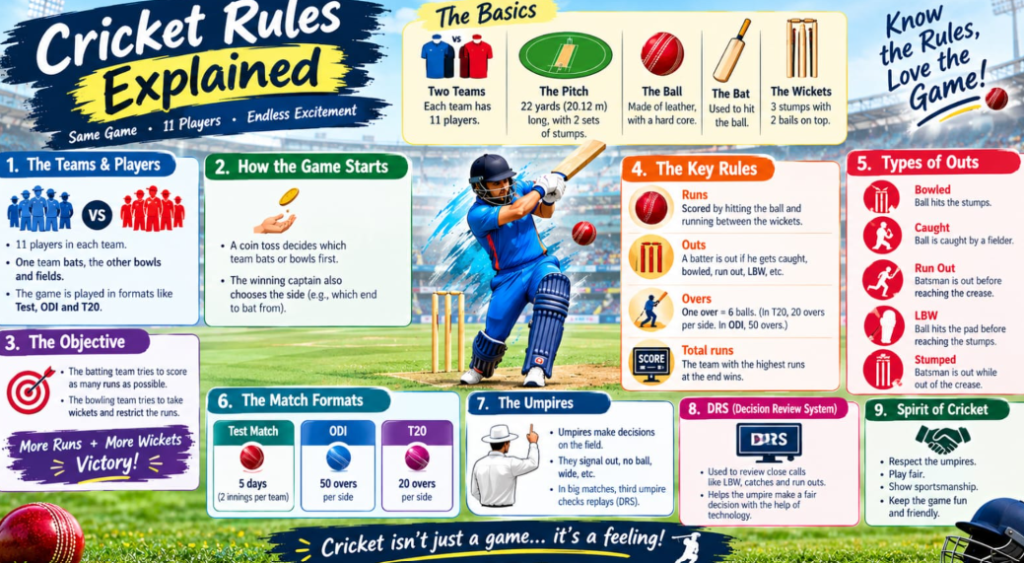
How a Batter Can Be Dismissed
The fielding team aims to get batters out. Each type of dismissal is often called a wicket.
Here are key ways a batter can be out.
Bowled
A batter is bowled when a legal delivery strikes the wicket and breaks it, as long as the rules for that dismissal apply.
Caught
A batter is out caught if a fielder takes the ball after it is hit with the bat or the hand holding the bat, and the ball does not touch the ground first.
LBW
LBW means Leg Before Wicket.
A batter may be given out LBW when the ball hits the batter’s body instead of the bat, and it would have hit the wicket, if the batter had not blocked it. The Laws list conditions that must be met.
The call also depends on key details. These include where the ball bounced, where it hit the batter, and whether the bat made contact first.
Not every ball that hits a leg is LBW. The umpire must weigh the full set of conditions.
Run Out
A run out occurs when a batter is away from their ground during a running attempt, or under other relevant situations, and the fielding side breaks the wicket in time.
For instance, a batter tries for another run. If they do not make it to the crease in time and the fielder hits the wicket, they can be run out.
Stumped
A batter is stumped when they are beyond the crease. They are not trying to run. The wicketkeeper then gets the ball and legally breaks the wicket.
Hit Wicket
A batter can be given out hit wicket if their body or bat knocks their own wicket. This happens while they are playing at the ball or right when they begin a run. The call must follow the Law.
Powerplay in cricket
A powerplay is a part of a limited-overs match. During this time, fielders cannot stand outside the inner fielding circle in certain numbers.
The goal is to push teams toward more attacking cricket. It also helps batters find chances to hit boundaries.
Men’s ODI powerplay rules
For standard men’s ODI matches, the first powerplay is the first 10 overs. In that span, only up to two fielders may be outside the inner circle. After that, field placement limits change.
Men’s T20 international powerplay rules
In standard men’s T20 international matches, the powerplay lasts for the first six overs. Here too, up to two fielders can be outside the inner circle.
Note on powerplay rules
Powerplay rules are set by the playing conditions. They do not work the same way in every competition. Other leagues or tournaments can have different limits.
Cricket formats: Test, ODI, and T20
Cricket is not one single style of match. The length of the game changes how teams plan batting and bowling.
Test cricket
Test cricket is the longest format. It is usually played over as many as five days.
Each side bats twice. That setup gives more room for tactics. Teams can also focus on defense and longer bowling spells.
A Test match can end as a win, a tie, or a draw. A draw happens when no side gets a result by the end. This can be true even if one team has a lead.
One Day International (ODI)
An ODI is a limited-overs format. Usually, each team faces 50 overs.
The side with more runs wins, as long as the game finishes with a result under the rules for that match.
If scores are level at the end of a completed ODI, it is a tie. Some tournaments add other steps to pick a winner.
T20 cricket
T20 is the shortest standard international format. Usually, each team has 20 overs.
Batters often try to score faster. Bowlers aim to take wickets and slow down the run rate.
Because the match is short, powerplays matter a lot. Boundary hitting matters too. Bowling changes and fielding limits also take extra importance.
DLS method in cricket
The Duckworth-Lewis-Stern method, known as DLS, is used in many limited-overs games. It comes into play when play is interrupted. Rain is a common reason.
DLS sets a new target. It is based on the resources left for both sides. Those resources include overs and wickets.
For instance, if rain cuts a chase short and fewer overs are left, the target can be adjusted. The idea is to compare teams fairly under the new number of overs.
The DLS target is not only about how many overs were lost. It also looks at what is still available when the break happens. It also considers the resources left to the team chasing.
Free hit in cricket
A free hit is an extra batting chance after certain types of no-ball. The exact cases depend on the competition’s playing conditions.
When a delivery is a free-hit ball, the batter is not usually out in several usual ways. For example, the batter is generally not dismissed by being bowled, caught, or LBW.
Even so, run outs can still happen sometimes. The exact free hit rules depend on what the match rules say.
Frequently Asked Questions About Cricket Rules
How many players are on a cricket team?
A usual cricket side has 11 players. In a match, only the players allowed under the Laws and match rules take part in each role.
How many balls make up an over?
An over has six legal balls. No-balls and wides do not count as legal balls for that six.
Can a batter reach six runs without hitting a six?
Yes. A batter can make six by running between the wickets. It can also come from mixing running with a boundary. Still, a “six” on its own means the ball went over the boundary without touching the ground in the field of play.
What is the difference between a no-ball and a wide?
A no-ball is called when the bowler breaks a rule. A wide is called when the ball is too far from the batter to play in a normal way. In limited overs, both usually give one extra run and add one more ball.
Conclusion
Cricket rules feel simpler once you break the game into runs, ways to get out, extra runs, and the rules that depend on the format.
Whether it is Test cricket, an ODI, or a quick T20 game, these basics help you understand what the umpires decide and why.
For more cricket content, check the latest IPL points table and other cricket records and tournament guides on Cricket Inshight.