

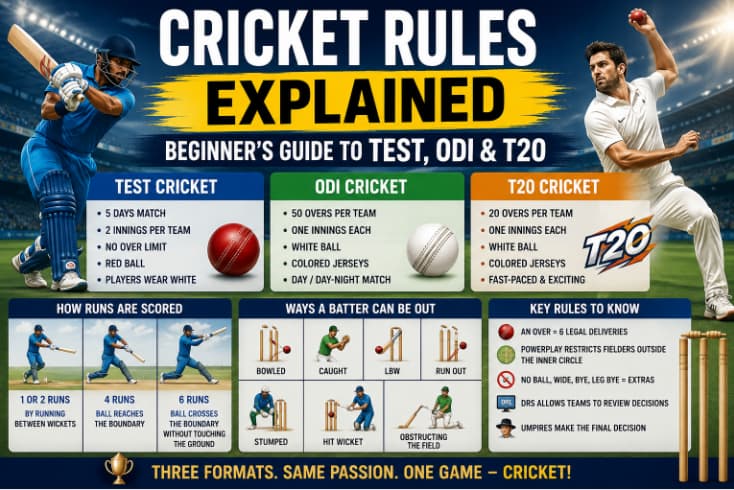
Cricket Rules Explained is your complete guide to getting your head around one of the world’s most popular sports . Even though millions of fans watch cricket every day, plenty of newcomers still see the rules as confusing. Happily, once the basics click, the game feels much easier to track, and also more satisfying to watch. In this Cricket Rules Explained guide , you’ll walk through the essentials of striking and defending , bowling, keeping score, plus the key differences between Test cricket, ODI , and T20 cricket, so you can follow each game with confidence.
This Cricket Rules Explained: Beginner’s Guide to Test, ODI & T20 will walk you through how cricket works, the various match types, scoring approaches, what each player role means, how wickets fall, plus fielding limits and many other details. Whether you are catching the ICC Cricket World Cup, IPL, or a neighborhood game, this guide should make it much simpler to understand what is happening.
What Is Cricket?
Cricket is a bat-and-ball sport played between two teams, each with eleven players. One team is on the batting side to pile up runs, while the other bowls and fields to stop that happening. After a side finishes its innings, the teams exchange roles again.
The winner is decided by which team scores more runs, but the exact method depends on the rules of the match format being played.
Basic Objective of Cricket
In simple words, the goal is this:
- The batting team tries to add as many runs as possible.
- The bowling team aims to dismiss batters and also restrict the runs.
- Whichever team ends up with the higher score wins.
That part looks easy, however each format brings its own tactics, and small problems to solve in different ways.
Cricket Ground Explained
A cricket ground is usually oval shaped, with a rectangular strip called the pitch set in the middle.
Key areas include:
- The pitch (22 yards long)
- The wickets (three stumps and two bails)
- The boundary rope
- The inner field
- The outfield
Most of the important action happens on the pitch, or right around it.
Cricket Equipment
Players use specialized gear for the game, and it is not just optional stuff.
Batting Equipment
- Cricket bat
- Helmet
- Gloves
- Pads
- Abdominal guard
- Thigh guard
Bowling equipment
Bowlers mostly use:
- Cricket ball
- Cricket shoes
Wicketkeeper equipment
- The wicketkeeper wears:
- Keeping gloves
- Pads
- Helmet (when standing close to the action)
Cricket Rules Explained: Understanding overs
An over is made up of six legal deliveries, bowled by the same bowler.
After finishing an over:
- Another bowler starts from the opposite end
- The previous bowler does not bowl consecutive overs.
Overs decide the duration of ODI and T20 games.
Cricket Rules Explained: Cricket match formats
One of the biggest differences in cricket comes from its formats, and how each one is played.
Test cricket
Test cricket is the longest version of the sport.
Main features include:
- Five-day match
- Two innings per team
- No over limit
- Players wear white clothing
- A red ball is used
Test cricket is often seen as the ultimate test of skill, patience and endurance.
Cricket Rules Explained: One Day International (ODI)
ODIs introduced a limited over style of cricket , which people still talk about a lot.
Some key things to remember are this: 50 overs per team, only one innings per side, they use a white ball and teams wear colored jerseys. Matches can be day games, or even day night fixtures, so the timing changes but the format stays the same. In general ODI cricket balances hard hitting with bowling plans that are a bit more strategic than in some shorter formats.
Now Twenty20, or T20, is the fastest growing format that has taken over headlines.
Its setup is pretty direct : 20 overs per team, roughly a three hour window, and the whole approach leans toward high tempo, high aggression batting. It is also built for entertainment , so you see fast paced action again and again. Leagues like the IPL have made T20 extremely popular across the world.
How Runs Are Scored
The batting side main goal is to collect runs.
Batters can earn runs by doing things like running between the wickets and striking boundaries. There are also extras that can be added, those come from the bowler side, depending on what happens.
Four Runs
A batter gets four runs when the ball reaches the boundary after it has touched the ground.
Six Runs
A batter gets six runs when the ball goes over the boundary without touching the ground.
Sixes are among those moments that feel the most exciting in cricket.
Extras in Cricket
There are moments when runs are credited, even if the batter never truly makes contact, and yeah it happens more than people think. Extras, in cricket terms, are still added to the team total so the scoreboard keeps moving.
Extras usually cover a few things, like:
- Wide
- No Ball
- Bye
- Leg Bye
- Penalty Runs
All of those count toward what the team scores overall, even when the ball play is kind of messy.
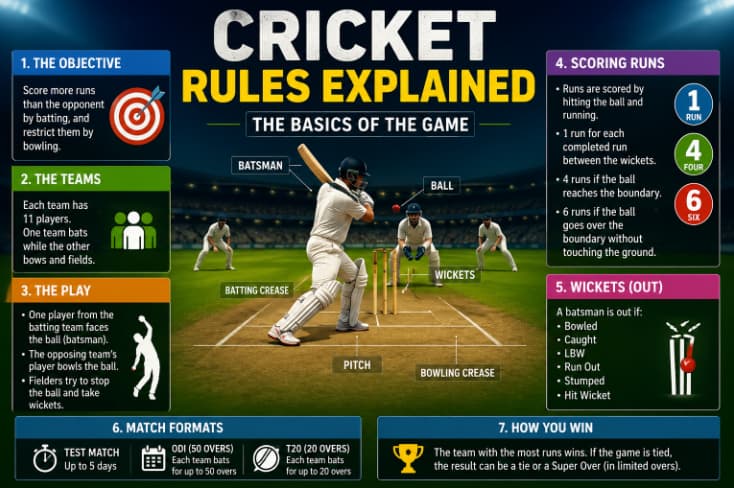
Cricket Rules Explained: Ways a Batter Can Be Out
If you want to learn the game properly, you really need to understand dismissals and how a batter can be taken out.
Bowled
The bowler strikes the stumps directly.
Caught
A fielder takes the ball before it touches the ground. That simple.
LBW (Leg Before Wicket)
The batter deflects the ball using the leg, and it would have gone on to hit the stumps.
Run Out
A batter does not get back to the crease in time, and the stumps get broken before they arrive.
Stumped
The wicketkeeper removes the bails when the batter is outside the crease.
Hit Wicket
The batter accidentally knocks over their own stumps.
Obstructing the Field
The batter blocks a fielder in a way that is not allowed.
Cricket Rules Explained: Fielding Positions
Each player ends up with a designated role on the field.
Common positions include,
- Slip
- Gully
- Point
- Cover
- Mid-off
- Mid-on
- Square Leg
- Fine Leg
- Third Man
- Long On
- Long Off
- Deep Midwicket
Captains tweak the field arrangement based on the moment in the game, not just the rules. Like sometimes it changes because the batters are set, and sometimes because of the last over, or the way the pitch is behaving.
Cricket Rules Explained: Bowling Types
Most bowlers can be grouped into two fairly clear lanes.
Fast Bowlers
These bowlers lean on:
- Speed,
- Swing,
- Seam movement,
- Bounce
Spin Bowlers
These bowlers depend on:
- Turn,
- Flight,
- Accuracy,
Variation
In practice, both approaches matter, across every format.
Powerplay Rules
Powerplays limit how many fielders are allowed beyond the inner circle.
ODI Powerplay
In the opening 10 overs, only two fielders can be outside the 30 yard circle, and then the limits shift as the innings moves forward.
T20 Powerplay
In the first six overs, only two fielders can sit outside the circle.
Powerplays push teams toward aggressive batting.
Free Hit Rule
A Free Hit comes after specific No Balls.
During a Free Hit:
- The batter cannot be dismissed in most common ways.
- Batters usually try for larger scoring swings.
- The bowlers feel extra pressure.
So this rule makes T20 and ODI games even more thrilling.
Duckworth-Lewis-Stern (DLS) Method
Rain interruptions happen in matches, and DLS helps handle the revised target.
The DLS method tweaks the target score considering, overs remaining, and also wickets lost
This arrangement keeps things fair in games that get shortened
Umpires in cricket
Every cricket match has on-field umpires, who handle enforcing the laws
Their responsibilities cover things like, giving decisions, checking No Balls, keeping an eye on fair play, and managing match conditions
In international matches they also bring in a third umpire for TV reviews, when needed
Cricket Rules Explained: Decision Review System DRS
These days, close calls can be reviewed using technology
DRS typically brings together ball tracking , UltraEdge, and Hot Spot in some competitions
Also each side gets limited reviews during the match
- Toss and its importance
- Before a match begins
- The captains toss a coin
Whoever wins the toss, gets to decide whether to bat or bowl first
That choice often depends on pitch condition, weather, and the match format
Follow on rule in Test cricket
This is specific to Tests, where the follow-on lets one team bat again right away if they fall far behind after the first innings
It can lead to lively recovery chances
Tie , Draw, and No Result
Different formats have different results, really.
Tie
Both teams end up with matching totals.
Draw
Happens only in Test cricket, when time runs out before anyone can force a result.
No Result
Most often occurs when rain stops enough overs from being completed.
Spirit of Cricket
Beyond the official laws, cricket also carries an idea of sportsmanship.
Players are expected to
- Respect opponents
- Respect umpires
- Play fairly
- Accept decisions calmly
The Spirit of Cricket is one of the game’s main guiding ideas.
Beginner Tips for Watching Cricket
If it’s your first time watching cricket
- Learn the basic field roles.
- Get a feel for overs and innings.
- Keep checking the scoreboard.
- Look closely at captaincy choices.
- Pay attention to bowling changes.
- Follow the Powerplay rules.
- Learn common umpire signals.
- Understand how dismissals happen.
After a few matches, you’ll start noticing patterns , plus the match moments become easier to read.
Final Thoughts
Hopefully, this Cricket Rules Explained: Beginner’s Guide to Test, ODI & T20 has made the sport feel more straightforward. Even if cricket looks complicated at the beginning, the core rules are simple once you understand the basics, of batting, bowling, fielding, scoring, and dismissals. Each format, Test, ODI, and T20, brings its own style of play, so cricket stays enjoyable for every type of fan. As you keep watching matches you’ll start noticing strategies, player roles, and match moments faster, and you’ll get to appreciate the game even more.