

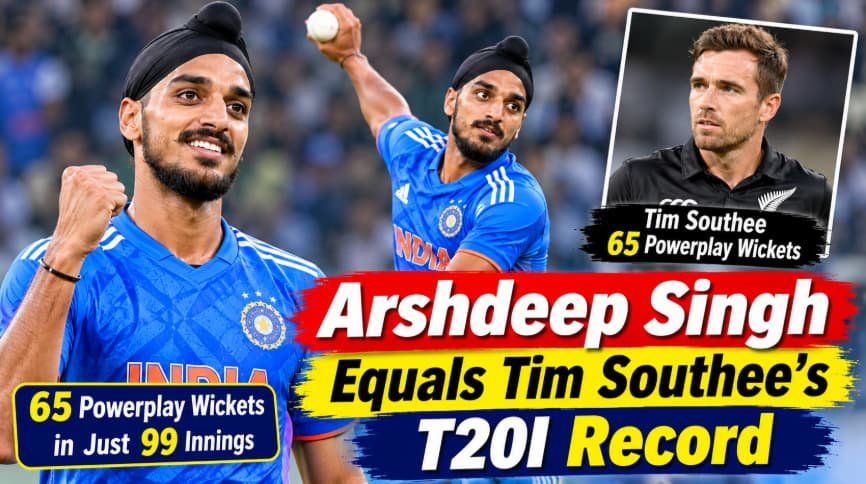
Arshdeep Singh equals Tim Southee’s T20I record is adding another chapter to his international record. During the fifth T20I vs New Zealand in Hamilton on November 1, 2026, the Indian left-arm fast bowler reached a big mark. After Finn Allen was dismissed, Arshdeep matched Tim Southee’s T20I record. This is for the most powerplay wickets by a bowler from ICC Full Member countries.
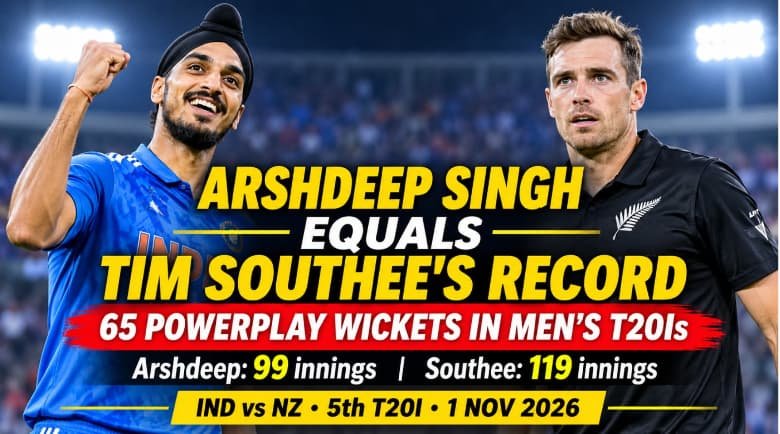
Arshdeep took 65 wickets in the first six overs of men’s T20Is. He did it in 99 innings. Tim Southee, the former New Zealand pacer, needed 119 innings to get to the same powerplay wicket count.
This shows how much Arshdeep has become part of India’s bowling plans. He also keeps giving early wickets when the new ball is in play.
Arshdeep Singh Matches Tim Southee’s T20I Mark vs New Zealand
The key moment came in the fifth and final T20I at Seddon Park in Hamilton. New Zealand were trying to chase India’s total. Arshdeep opened the second over of the chase.
On the third ball, he bowled a short-of-length delivery with extra bounce. Finn Allen went for a pull shot but missed the timing. The ball came off the top edge. It looped toward midwicket, and Ishan Kishan took the catch.
Allen made only two runs off his first three balls. Then he walked back. Still, the wicket mattered a lot. It took Arshdeep to his 65th powerplay wicket in men’s T20Is.
After that, Arshdeep joined Tim Southee on the top of the powerplay wicket list for Full Member nation bowlers.
Arshdeep Singh vs Tim Southee: Powerplay Wickets
Both Arshdeep and Southee have 65 powerplay wickets in men’s T20Is. The difference is the number of innings. Arshdeep reached the tally faster.
Below is the top list of powerplay wicket-takers from Full Member nations:
| Bowler | Team | Powerplay wickets | Innings |
|---|---|---|---|
| Arshdeep Singh | India | 65 | 99 |
| Tim Southee | New Zealand | 65 | 119 |
| Blessing Muzarabani | Zimbabwe | 62 | 95 |
| Richard Ngarava | Zimbabwe | 62 | 96 |
| Shaheen Shah Afridi | Pakistan | 60 | 99 |
The opening overs tell the story of Arshdeep. In 99 innings, he has taken 65 wickets. That is a steady rate, and it shows he often matters right from the start.
Southee still sits near the top in T20I fast bowling. So when Arshdeep matches that powerplay mark, it is a big sign of how well he is settling into that role early.
Why Arshdeep Singh Works So Well in the Powerplay
The first six overs shape a T20 chase or start. Many batters try to score fast at this point. Field limits open up routes to boundaries, and gaps can be found more easily.
For bowlers, it is a tough mix. You have to slow the runs. At the same time, you want wickets. Arshdeep has built the basics and the extras for that job.
- Left-Arm Angle
Arshdeep bowls with a left-arm angle. That changes how right-handed batters read the ball. The delivery can come into them or drift away, depending on the setup.
That shift can stop batters from finding a clean rhythm early.
- Swing Off the New Ball
With the new ball, Arshdeep can bring swing into play. Even a small amount can upset timing. It can also push batters into edges, mistimed shots, and quick exits.
- Length Choices
The Finn Allen dismissal highlighted why length matters. Arshdeep went to a short-of-length ball. It gave extra bounce and forced the batter into a risky pull attempt.
He was not only relying on speed. He used the ball placement and conditions to raise the pressure.
- Control Over Variations
In the powerplay, you cannot lose your line and your pace. Arshdeep blends fuller balls with shorter ones. That gives him more than one way to test the stumps and challenge a batter’s technique.
Those traits have made him one of the key new-ball bowlers for India in T20I cricket.
Arshdeep Singh’s Rise in T20 International Cricket
Arshdeep Singh equals Tim Southee’s T20I record vs England in July 2022.
Not long after that, he started playing a big role in India’s bowling lineup.
He bowls left-arm pace. He also gets swing at times. His yorkers are hit on target more often than not. Over time, those steady efforts brought him to an important point.
Arshdeep Singh then matched Tim Southee’s T20I record for the most powerplay wickets by a bowler from a Full Member nation.
His work in T20 has helped India form a strong attack. He can take wickets with the new ball, then he can also add value late in the innings.
One of his top moments came at the 2024 ICC Men’s T20 World Cup. Arshdeep took part in India’s title run. He also finished as one of the leading wicket-takers, with 17 wickets.
Since then, his international numbers have kept moving up. He handles different game states well, so he stays useful for the Indian side.
Arshdeep Singh Hits 150 T20I Wickets
Arshdeep Singh is closing in on a rare mark in T20I cricket. In the fourth T20I vs New Zealand at Auckland, he became the first Indian male bowler to reach 150 wickets in T20 Internationals.
That moment adds weight to his role in India’s T20I plans. Getting to 150 wickets at a young age also points to steady work across venues and opponents.
He has also shown he can impact multiple parts of an innings. In the early overs, his new-ball work helps India get quick wickets. Later on, his slower balls and yorkers give the side more control and chances.
India will need this kind of bowler as they shape their attack for upcoming events. Arshdeep’s form matters in that process.
Powerplay Wicket List: Arshdeep Joins the Elite
The powerplay wicket record puts fast bowlers in the spotlight. Several names stand out, and they are backed by long runs of output.
Tim Southee built his status in New Zealand through steady seasons. His swing with the new ball helped him earn trust as one of the more dependable pace options.
For Zimbabwe, Blessing Muzarabani and Richard Ngarava are also on the list. In the Full Member group, both have reached 62 powerplay wickets.
Shaheen Shah Afridi is another key name. The Pakistan left-arm pacer is often a threat early, especially when facing top-order batters.
Arshdeep appearing in this group shows how much ground he has covered since his T20I start.
Why This Number Matters for India
India have long valued pacers who can strike early in T20 cricket. Wickets in the powerplay can shift a match fast. Once the batters lose early starts, they often have to change plans.
In this phase, Arshdeep gives India a left-arm option they can count on. He can pressure right-handers and left-handers, which helps the attack feel less predictable.
The milestone also hints at where India’s pace group is heading. With senior bowlers and younger ones sharing duties, the team has more choices when it sets up for a T20I.
For Arshdeep, the next step is to keep that same level and keep moving past what others have set. Since he reached 150 wickets in fewer innings than Southee, he has a real chance to raise the bar for powerplay bowling.
Arshdeep Singh Hits 150 T20I Wickets
Arshdeep Singh is closing in on a rare mark in T20I cricket. In the fourth T20I vs New Zealand at Auckland, he became the first Indian male bowler to reach 150 wickets in T20 Internationals.
That moment adds weight to his role in India’s T20I plans. Getting to 150 wickets at a young age also points to steady work across venues and opponents.
He has also shown he can impact multiple parts of an innings. In the early overs, his new-ball work helps India get quick wickets. Later on, his slower balls and yorkers give the side more control and chances.
India will need this kind of bowler as they shape their attack for upcoming events. Arshdeep’s form matters in that process.
Powerplay Wicket List: Arshdeep Joins the Elite
The powerplay wicket record puts fast bowlers in the spotlight. Several names stand out, and they are backed by long runs of output.
Tim Southee built his status in New Zealand through steady seasons. His swing with the new ball helped him earn trust as one of the more dependable pace options.
For Zimbabwe, Blessing Muzarabani and Richard Ngarava are also on the list. In the Full Member group, both have reached 62 powerplay wickets.
Shaheen Shah Afridi is another key name. The Pakistan left-arm pacer is often a threat early, especially when facing top-order batters.
Arshdeep appearing in this group shows how much ground he has covered since his T20I start.
Why This Number Matters for India
India have long valued pacers who can strike early in T20 cricket. Wickets in the powerplay can shift a match fast. Once the batters lose early starts, they often have to change plans.
In this phase, Arshdeep gives India a left-arm option they can count on. He can pressure right-handers and left-handers, which helps the attack feel less predictable.
The milestone also hints at where India’s pace group is heading. With senior bowlers and younger ones sharing duties, the team has more choices when it sets up for a T20I.
For Arshdeep, the next step is to keep that same level and keep moving past what others have set. Since he reached 150 wickets in fewer innings than Southee, he has a real chance to raise the bar for powerplay bowling.
India vs New Zealand: Fifth T20I
Arshdeep hit a new milestone in the fifth T20I of India’s 2026 tour of New Zealand. India put up 191/8 after choosing to bat first. Ishan Kishan and Shreyas Iyer made key runs in the innings.
New Zealand made a strong reply. Tim Seifert and Glenn Phillips helped the hosts move ahead after Finn Allen was sent back early. Seifert struck 93, and Phillips finished unbeaten on 65.
In the end, New Zealand won by seven wickets. They also wrapped up the five-match T20I set with a 3–2 score.
Even with the loss in the last game, Arshdeep’s personal landmark stood out for India. He dismissed Allen, and that wicket added to his rising T20I record.
Conclusion
Arshdeep Singh has now reached another notable mark in international cricket. In this match, he took his 65th powerplay wicket versus New Zealand. With that, he matches Tim Southee’s T20I record for bowlers from Full Member teams.
Arshdeep reached the number in 99 innings. Southee got there in 119 innings. It also shows how well Arshdeep can handle the new ball, change his pace, and pressure batters early.
At 27, Arshdeep has time on his side. If his current form holds, he could go past this mark soon. He may also build a stronger reputation as a powerplay bowler in T20I cricket.