

The LBW Rule in cricket is a key law that many fans try to learn. LBW means Leg Before Wicket. In simple terms, the umpire can give a batter out when the ball strikes the batter’s body instead of the bat, as long as the law’s conditions are met.
LBW can swing the outcome in tight games. You also see it often during loud appeals, with batters and fielders waiting for the umpire to speak. If you are new to the sport, or if you watch matches regularly, knowing LBW makes it easier to follow Test matches, ODIs, and T20 cricket.
In this article, we cover what the LBW Rule is, the main conditions, typical situations, how the umpire makes a call, and how the Decision Review System (DRS) fits in.
What Is the LBW Rule in Cricket?
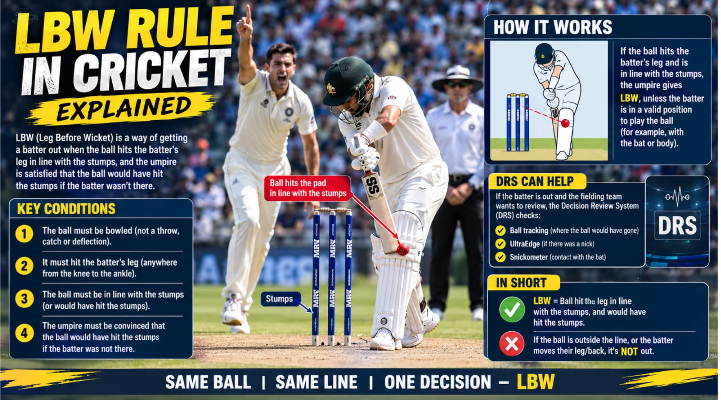
LBW stands for Leg Before Wicket. A batter may be out if the ball hits the batter’s body in a scenario where the ball would have gone on to hit the stumps. This depends on the laws about where the ball pitched, where it struck the batter, and whether the bat was hit first.
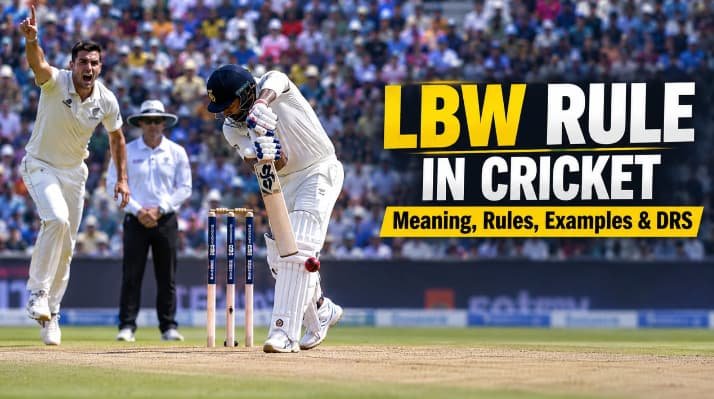
For instance, picture a fast bowler sending in a straight ball. The batter misses the shot. The ball then lands on the front pad and is in line with the stumps. If the ball would have struck the wicket and the other LBW requirements are satisfied, the umpire may declare the batter out.
Still, pad contact alone does not end the innings. The umpire must check multiple points before reaching a decision.
What Does LBW Stand For?
LBW means Leg Before Wicket. Even though the word “leg” appears in the name, the ball can hit more than just the legs. The law looks at the ball striking the batter’s body.
The purpose of LBW is to stop a batter from blocking a delivery with their body when the ball would have hit the wicket anyway. It also lets bowlers take wickets even if the bat does not get a touch.
The LBW Rule is used in Test cricket, ODI cricket, and T20 cricket. The core idea stays the same in each format. At the same time, match situations and review steps can differ.
LBW rule in cricket: what it means, how it works, examples, and DRS
Introduction
The LBW rule is a key part of cricket. LBW means leg before wicket. In simple terms, it lets an umpire rule a batter out if the ball hits the batter on the leg area, not the bat, and it would likely have gone on to hit the stumps.
You can see this rule decide tight finishes. It also brings drama during appeals, because the batter has to wait for the umpire’s call. Fans in Tests, ODIs, and T20 games all run into LBW, so it helps to know the basics.
Here we break down the LBW rule in cricket. You will also learn the main conditions, typical cases, what the umpire looks for, and how DRS can be used when calls are close.
Main Situations for an LBW Call
To follow the LBW Rule in cricket, it helps to know what an umpire looks for. Under Law 36, every required condition has to be satisfied. Only then can a batter be given out LBW
- No LBW on a no-ball
A batter cannot be given LBW on a no-ball. Even if the ball strikes the pad right in front of the stumps, the batter is still safe if the delivery was called a no-ball.
- The spot where the ball lands
If the ball bounces before it reaches the batter, it must land in the right area. It has to pitch between the wickets, or pitch on the off side of the striker’s wicket. If it lands outside the leg stump, LBW is not allowed.
A full toss is a different case. The ball has not bounced before reaching the batter. It can still lead to LBW if the other checks fit the rules.
- The ball must hit the body first
For LBW, the ball has to touch the batter before it touches the bat. If the bat gets there first, then the batter is not out LBW by this point.
That is why umpires and reviews look closely at what made contact first, ball or bat.
- Where the contact lines up
If the batter tried to play the ball with the bat, the impact has to line up with the stumps. If the batter did not make a real attempt to play it, then impact outside the off stump can still count, as long as the other requirements are met.
Impact outside leg stump does not count for LBW.
- Would it have hit the stumps anyway
The last thing is this. The ball must be on track to hit the wicket, if the batter had not blocked it with the body. If the ball would have gone past the stumps, then LBW should not be given.
This is often where the umpire needs help from ball-tracking and careful checking.
How LBW decisions are made (quick examples)
These short cases help explain the LBW rule.
Example 1: Out LBW
A bowler sends down a straight ball. The batter goes for the shot and misses. The ball lands on the pad, in line with the stumps. The ball would have gone on to hit the wicket, and it was not a no-ball. If the rest of the LBW checks are met, the umpire can call “out”.
Example 2: Pitch is outside leg stump
A spinner bowls. The ball pitches outside the leg stump. It then turns and hits the pad. Even if the ball would have struck the stumps, this is not out LBW. The pitch spot is the key here.
Example 3: Bat first, then pad
A fast bowler bowls a full ball. The batter plays a defensive stroke. The ball touches the bat first. After that, it goes on to hit the pad. Since the bat was first contact, the batter cannot be given out LBW.
Example 4: It would not hit the stumps
The batter misses a shot. The ball hits the pad. But the ball is going down the leg side. If it had kept going, it would have missed the stumps. In that case, the batter is not out LBW.
Example 5: No real attempt to play
The batter lets a delivery go through, without a real attempt to play. The ball pitches in line, or on the off side. It then hits the batter outside the off stump. The ball would have hit the wicket. The batter can be called out LBW, as long as the other LBW conditions also hold.
These cases show that an umpire looks at the pitch, where the ball first hits, what the batter did, and where the ball would have gone.
What’s the Difference Between Pitching, Impact, and Hitting the Wicket?
When an LBW call goes to DRS, people usually hear three terms. They point to separate moments during the ball’s path.
- Pitching: Where the ball first lands on the pitch, assuming it lands before the batter.
- Impact: The moment the ball first makes contact with the batter’s body.
- Wickets: Whether the projected line would go on to hit the stumps.
Together, these facts let officials judge an LBW review. A ball can land in a permitted spot and still strike the batter. Even then, the batter might be ruled not out if the ball would have gone past the stumps.
What Does Umpire’s Call Mean in LBW?
Umpire’s Call is a label used in the Decision Review System. It shows up when tracking tech gives a thin or close call in specific parts of the check. This can include the impact spot or whether the stumps would be hit.
Say the ball looks like it is just brushing the edge of a stump, not hitting it clearly. During the review, the data may place the outcome inside the Umpire’s Call area.
The final call still depends on what the on-field umpire decided first, plus the playing conditions. Umpire’s Call does not mean the tracking is wrong. It exists because these measurements can be uncertain when they are close.
How Does DRS Support LBW Calls?
DRS, or Decision Review System, lets match officials use tech to re-check some on-field calls. A player can ask for a review only when the rules and playing setup allow it.
In an LBW review, officials look at two main things. First, they check if the ball was a no-ball. Then they confirm that the ball hit the bat before it struck the batter’s body. If the batter can still be out, ball-tracking data may show:
- Where the ball pitched.
- Where the ball first made contact with the batter.
- Whether the ball would have gone on to hit the stumps.
The third umpire then decides using the proof on hand and the required review steps. DRS can fix obvious mistakes. For close calls, Umpire’s Call may decide the outcome.
For viewers, knowing these steps makes TV reviews easier to follow.
Why Do Umpires Say Not Out When the Ball Hits the Pads?
Pad contact alone does not always mean wicket. An umpire may still give not out for a few different reasons:
- The delivery was a no-ball.
- The ball pitched outside the leg stump line.
- The ball touched the bat before it hit the body.
- The contact point does not satisfy the needed rules.
- The ball would not have struck the stumps.
The umpire has to follow the full law. They cannot decide only by the fact that the pad was hit. Because of that, a strong appeal from the bowling side does not always end in dismissal.
How Can Batters Lower Their Risk of LBW?
Batters can lower the chance of an LBW dismissal by working on technique and better judgement. These ideas can help newer batters and those still building skill.
- Work on footwork. Move forward to fuller balls when it makes sense, and get set in a stable stance to defend or go at the ball.
- Track the ball from the start. Following it from the bowler’s hand helps judge line and length.
- Use the bat with care. Solid defensive form can help you get the bat in first, before the pad comes into play.
- Understand bowler changes. Spinners may alter flight, turn, and speed. Fast bowlers can bring swing or seam.
- Practise playing straight. Balanced defence with a straight bat can help you deal with deliveries aimed near the stumps.
None of this guarantees safety from LBW. Still, these habits can help batters choose better options at the crease.
Why the LBW Law Matters in Cricket
The LBW rule keeps the game even for both sides. It stops a batter from using their body to block a ball that should have gone on to the stumps.
It also pushes bowlers to be precise. A pace bowler can aim at the stumps with speed and movement. A spinner can threaten the batter with turn and the right flight.
LBW brings extra pressure at the crease. A bowler might probe with balls that stay outside the stumps, then come in near the pads. The batter then has to decide fast. Go for a forward defensive, let it go, or play a shot.
When fans know LBW, they also understand why umpires wait before they rule on an appeal. They can see why DRS can matter when the result is close.
Frequently Asked Questions About LBW in Cricket
- What does LBW stand for?
LBW means Leg Before Wicket. It falls under Law 36 in the Laws of Cricket.
- Can a batter be out LBW if the bat gets hit first?
No. If the ball hits the bat first, then the batter cannot be out LBW on that ball.
- Can LBW happen on a no-ball?
No. A batter cannot be given out LBW when the delivery is a no-ball.
- If the ball pitches outside leg stump, is LBW still possible?
No. If the ball pitches outside leg stump, the batter cannot be out LBW, even if the ball would have hit the stumps later.
- If the pad impact is outside off stump, can the batter still be out LBW?
Yes, but only in some cases. If the batter does not make a real effort to play the ball, then an impact outside off stump can count, as long as the other LBW steps are satisfied.
- Does the LBW law apply in T20?
Yes. It applies in Tests, ODIs, and T20. The match playing rules set how the review is handled.
- What is Umpire’s Call in an LBW review?
Umpire’s Call applies to some close ball-tracking results. The final call follows the on-field decision plus the DRS rules used for that match.
Conclusion
The LBW rule in cricket is not only about a ball touching the batter’s pads. Umpires have to judge if the delivery was legal. They also look at where the ball bounced. Next, they check if the bat met the ball first. After that, they consider where the ball hit the batter. Finally, they decide if it would have hit the stumps.
When you know what to check, LBW calls can feel clearer. The rule also shows how much comes down to a bowler’s accuracy and a batter’s timing. That is why it matters in cricket for everyone, from new players to seasoned pros.