

History of the Cricket World Cup has many matches people still talk about. It also has famous players, close championship games, and wins that changed records. Over time, the event moved from a small international contest to a major stop in world cricket. Each edition brought fresh names, tough rivalries, and scenes fans remember for years.
The first men’s Cricket World Cup ran in England in 1975. West Indies won the first edition, led by captain Clive Lloyd. After that, countries like India, Australia, Pakistan, Sri Lanka, and England kept adding their own trophy moments. The tournament also shifted as the years went on. Formats changed. Team numbers changed too. How teams played also evolved.
This guide looks at how the Cricket World Cup started. It covers big turning points, the list of men’s ODI World Cup winners, India’s well-known wins, and why the tournament matters in modern cricket.
1. How Did the Cricket World Cup Begin?
The men’s ODI Cricket World Cup started in 1975. Back then, most international cricket talk centered on Tests. Those matches could go on for five days. Then limited overs cricket grew, and it made room for a shorter world title event. Teams could now fight for a trophy without waiting days for results.
History of the Cricket World Cup started in 1975, with eight teams in the first tournament. England was the host country. The games were played in a 60-over setup. A red ball was used, and the players wore white kits. Back then the format was not like the 50-over matches we see now. Still, the aim stayed clear: make more runs than the other side and come out on top.
West Indies finished as the first men’s ODI World Cup champions. They beat Australia by 17 runs at Lord’s. Clive Lloyd captained the team and scored a standout century. That knock helped West Indies set an early tone for World Cup cricket.
The first World Cup did more than crown a winner. It helped the tournament become a major world sports event. Fans could see top teams face each other in one competition. Players also got a chance to etch their names into the sport’s biggest moments.
2. West Indies Lead the Way Early
West Indies won the first two Cricket World Cup tournaments for men. They took the trophy in 1975. Four years later, in 1979, they came back and held the title. In the final, they beat England.
The 1979 squad had stars. Viv Richards, Gordon Greenidge, and Joel Garner stood out. Richards hit with force. Garner’s bowling put pressure on opponents. With titles in consecutive World Cups, the side built a strong reputation in global cricket.
Then came another big shift in 1983. India had not made much noise in the first two events, but it still found a remarkable path to the final stages. That year produced one of the biggest upsets in World Cup history.
3. India’s Big Breakthrough in 1983
India won the 1983 Cricket World Cup and it reshaped what people expected from Indian cricket. Kapil Dev led the group. In the final, India faced West Indies, the team that had won the last two editions.
In the final at Lord’s, India made 183 runs. The score was not huge on paper. Still, India’s bowlers and fielders played well together. West Indies were all out for 140. India won by 43 runs. It was also the first men’s ODI World Cup title for the country.
This victory became a key turning point. It lifted support for cricket across India. It also pushed more attention toward the limited-overs game. Many players later looked back at 1983 as a starting point for their own dreams.
Kapil Dev’s captaincy, the team’s unity, and their confidence are still part of the record of that run. The 1983 win also proved that being the top pick before the tournament is not required to win the World Cup.
For readers who want more on famous Indian batting and match stories, you can internally link this part to your article on Sachin Tendulkar Records in Cricket or to a future piece on India’s best World Cup moments.
4. Australia Claims Its First World Cup Crown in 1987
The 1987 Cricket World Cup was a turning point. It was co hosted by India and Pakistan. That made it the first men’s World Cup held away from England.
Another shift came in the rules. Each side played 50 overs per innings, not 60. This is the same length used in today’s men’s ODI games.
Australia beat England in the final in Kolkata. They won the match and took their first World Cup trophy. The win also proved Australia could handle conditions on the subcontinent. It helped kick off a long stretch of strong results.
Crowds were another big sign. The tournament drew large numbers and worked in different cricket regions. Putting it in South Asia boosted how the event was seen worldwide.
5. Pakistan and Sri Lanka Leave Their Mark on World Cups
The 1992 Cricket World Cup in Australia and New Zealand brought fresh ideas. Teams wore coloured kits. They used white balls. Games also began under floodlights for day night action.
These changes gave ODI cricket a more modern feel. The tournament looked new on the field and in the stands.
Pakistan won the 1992 title. Imran Khan led the team. They beat England in the final. Pakistan had a rough start at first. Then they gained momentum as the tournament went on. The rise they showed is still often remembered as a well timed turnaround.
Sri Lanka followed with a landmark win in 1996. They won their first men’s ODI World Cup. Arjuna Ranatunga led them. In the final at Lahore, Sri Lanka beat Australia.
Sri Lanka became known for a bold start in their innings. Much of that came from Sanath Jayasuriya and Romesh Kaluwitharana. Their aggressive batting shaped the way early overs were played.
Sri Lanka also showed what tactics could do in limited overs cricket. Their plan for the first 15 overs later influenced how teams batted in future tournaments.
6. Australia’s Golden Period: 1999 to 2007
Australia stood out as the top men’s ODI World Cup side after a long stretch of strong results.
With Steve Waugh in charge, Australia won the 1999 World Cup in England. Then they added trophies in 2003 and 2007, with Ricky Ponting leading the group. By winning in a row three times, they became the first men’s team to do so.
The 2003 final was played in Johannesburg. Australia beat India by 125 runs. Ricky Ponting made 140 not out, which helped lift the team to a big score. India fell short even though Virender Sehwag gave them real chances.
In 2007, Australia grabbed a third straight title, this time in the West Indies. Adam Gilchrist made 149 in the final against Sri Lanka. His innings had a big impact on the result.
What powered Australia in those years was solid batting options, careful bowling, and sharp work in the field. They also looked calm when matches turned tense. Their run later became a benchmark for other World Cup teams.
7. India Takes Another World Cup Title in 2011
India won the World Cup again in 2011, a major day for cricket supporters. The tournament ran across India, Sri Lanka, and Bangladesh. MS Dhoni led a strong group of players.
India beat Australia in the quarter-final. Then India handled Pakistan in the semi-final. After that, India met Sri Lanka in the final at Wankhede Stadium in Mumbai.
Sri Lanka made 274/6. India had to chase a tough total. Gautam Gambhir made 97 runs. Dhoni stayed at the crease and ended on 91 not out. His final six helped seal the win and still gets remembered.
India won by six wickets. It was their second men’s ODI World Cup trophy. Many fans felt this win mattered even more because it happened at home.
Sachin Tendulkar was also in the winning side. That made the moment feel huge for him, since he had played World Cups for years.
You can add an internal link here using the anchor text Sachin Tendulkar Records in Cricket if that article is published on your website.
8. Australia Closes the Gap and Wins in 2015
The 2015 Cricket World Cup was shared by Australia and New Zealand. Both countries showed good form. In the end, Australia beat New Zealand in the final at the Melbourne Cricket Ground.
New Zealand had a strong campaign. It won its group matches and reached its first men’s ODI World Cup final. Still, Australia restricted New Zealand and had it all out for 183. Australia then chased the target with seven wickets in hand.
Michael Clarke captained Australia in the final. Mitchell Starc and James Faulkner also played key roles with the ball during the tournament.
This win gave Australia its fifth men’s ODI World Cup title. It also showed how speed in bowling can match well with bold batting and sharp fielding.
9. England Wins a Wild Final in 2019
In 2019, the Cricket World Cup was held in England and Wales. The final turned into one of the most talked about matches in sports.
England faced New Zealand at Lord’s. Both teams finished their 50 overs on 241. So the game went to a Super Over. That Super Over also ended tied. England were picked as winners using the boundary-count rule that was in place then.
Some people questioned the decision. The result sparked debate on how tied finals should be settled. Even with that, England won its first men’s ODI World Cup title after several years of strong limited-overs cricket.
The tournament had big batting displays and many close games. Individual players also made major impacts. It also made clear that modern ODI cricket is fiercely competitive, with several teams able to fight for the trophy.
10. Australia Wins the 2023 Cricket World Cup
India hosted the 2023 men’s ODI Cricket World Cup. Lots of people followed the event. The home team went unbeaten during the group stage and also during the semi-final.
Then the final came at the Narendra Modi Stadium in Ahmedabad. India played Australia there. India made 240 runs. Australia reached the goal and won by six wickets.
Travis Head was the key batter. He scored 137 runs in a major innings. Pat Cummins captained Australia through the match. This win gave Australia its sixth men’s ODI World Cup trophy. It also kept Australia as the top team by titles in this competition.
The match showed how a World Cup can swing fast. One strong day can shape the result. India did well across the tournament, but Australia stayed calm in the final.
use the natural sentence: “For more cricket history and major tournament updates, explore our coverage of the ICC Cricket World Cup 2027.”
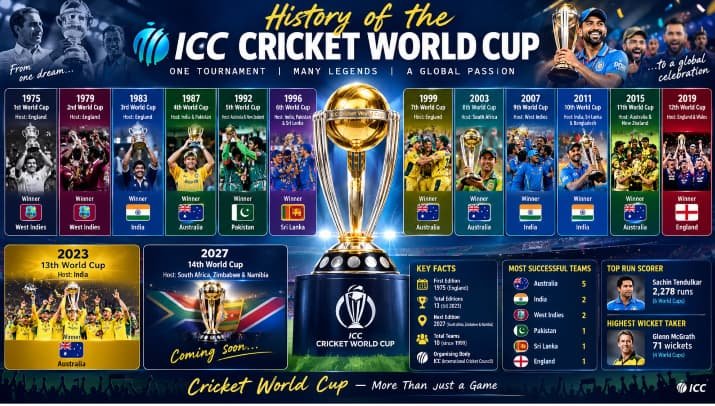
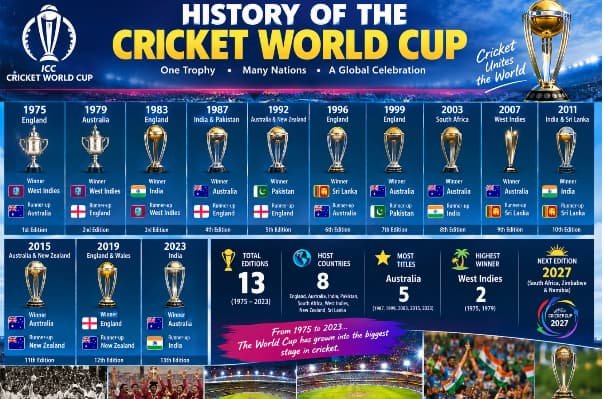
11. Men’s ODI Cricket World Cup Winners List (1975–2023)
This list shows every finished men’s ODI Cricket World Cup edition up to 2023.
- 1975: West Indies
- 1979: West Indies
- 1983: India
- 1987: Australia
- 1992: Pakistan
- 1996: Sri Lanka
- 1999: Australia
- 2003: Australia
- 2007: Australia
- 2011: India
- 2015: Australia
- 2019: England
- 2023: Australia
Australia has won six men’s ODI World Cup titles. That makes them the most successful side in the tournament’s history. West Indies took the first two titles. India won twice, in 1983 and 2011. Pakistan, Sri Lanka, and England each won one time.
12. Women’s Cricket World Cup: A Start That Matters
The Cricket World Cup story does not belong only to the men’s game. A women’s World Cup was held in England in 1973. That was two years before the first men’s World Cup.
In that first event, seven teams took part. England lifted the trophy. They beat Australia in the last match of the round robin stage. The tournament was set up before the men’s ODI World Cup began, so it stood out as a big moment for women’s cricket at the time.
After those early years, the women’s tournament kept growing. Australia often led the way. England and New Zealand also added titles. India made it to the final twice, in 2005 and 2017. Then, in 2025, India finally won its first women’s ODI World Cup.
The 2025 final ended with India beating South Africa by 52 runs. Shafali Verma and Deepti Sharma were key names in India’s win. This title was India’s first women’s ODI World Cup. It also became a notable turning point for the women’s game in the country.
This win adds another chapter to cricket World Cup history. It spans both the men’s and the women’s sides of the sport.
13. How the Cricket World Cup Changed With Time
The Cricket World Cup looks very different from its early versions. Over the years, several shifts reshaped the event.
Playing rules: The men’s game began with 60 overs per side in 1975. In 1987, it moved to 50 overs for each team. That approach is still used in men’s ODI World Cups.
Broadcast and review tools: Today’s matches rely on modern camera systems. There are ball tracking tools, edge checks, and video review. Officials can use these tools to confirm calls.
A wider fan reach: TV helped first, then digital platforms took over. Social media brought more attention too. Fans around the world can watch, read, and share match updates. Scores, clips, interviews, and breakdowns are easy to find across different apps.
Tactics and planning: Teams now use more detailed information. They look at batting and bowling match ups. They plan fielding spots and bowling options based on the pitch and match situation. Powerplay choices and death over execution matter a lot in modern ODI cricket.
Women’s World Cup: The women’s event began in 1973 and has grown into a major global competition. More people follow it now, and more teams take part over time.
All these changes helped the World Cup stay relevant. It continues to draw in new cricket fans as the sport moves ahead.
14. Why Is the Cricket World Cup So Important?
The Cricket World Cup is a big deal because it gathers top teams from around the world into one event. To lift the trophy, teams need more than talent. They need plans, steady form, teamwork, and calm nerves when the game turns tense.
For many players, the World Cup can shape what comes next. It can lift reputations fast. For fans, it leaves behind memories that do not fade. People still talk about India’s 1983 win, India’s 2011 title, Pakistan’s 1992 victory, and Australia’s strong runs. Those moments pull readers in year after year.
The tournament also helps the sport grow. New viewers get a reason to watch. Younger players get a chance to see how great performances look at the highest level. Fans can also track changes across time by using stats and old records, then compare one team or era with another.
For a cricket site like Cricket Inshight, World Cup history works as a lasting topic. Instead of a short match preview, a careful history guide can stay useful. It can be refreshed over time with correct details, helpful links, and updates from each new tournament.
Conclusion
The History of the Cricket World Cup shows how the sport grew into a global contest. The men’s tournament started in 1975, and West Indies won the first trophy. In 1983, India’s win shifted the future in a major way. Australia built a reputation for staying strong for years. England’s title came later, in 2019, after a final with drama.
The women’s competition started in 1973. It later reached another high point when India won its first title in 2025.
Each edition adds something fresh. You can find classic batting and bowling, plus newer tactical clashes. Still, the goal stays the same. The Cricket World Cup keeps bringing players and supporters together across countries.
If readers want more cricket history, notable player achievements, and tournament updates, Cricket Inshight can add related guides and match breakdowns to this article.