

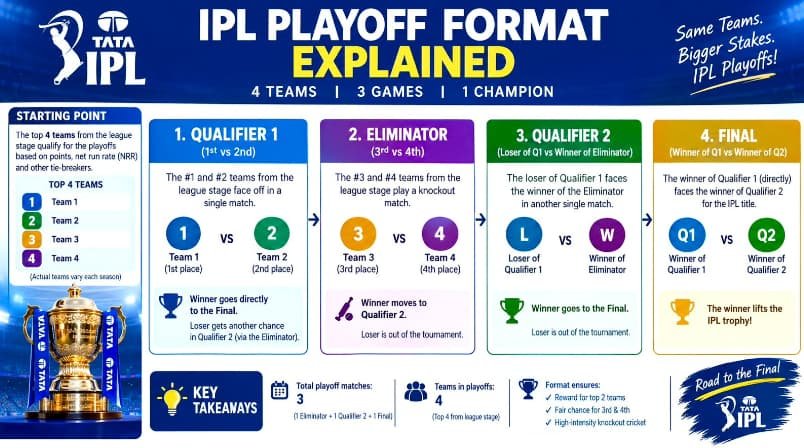
The IPL playoff format rewards league-stage consistency while retaining the pressure of knockout cricket. The top four teams on the points table advance, but they do not all begin on equal terms: the first- and second-placed sides receive two possible routes to the final, while the teams in third and fourth must win every remaining match. The four-match sequence is Qualifier 1, the Eliminator, Qualifier 2 and the final.
The IPL playoff route at a glance
Once the league stage ends, the teams are ranked by points. Net Run Rate is the primary tie-breaker if two or more teams are level on points. The top four progress to the playoffs, with their finishing positions determining both their first opponent and the margin for error available to them.
| Playoff match | Teams involved | Result |
| Qualifier 1 | 1st vs 2nd | Winner reaches the final; loser gets another match |
| Eliminator | 3rd vs 4th | Loser is eliminated; winner reaches Qualifier 2 |
| Qualifier 2 | Loser of Qualifier 1 vs winner of Eliminator | Winner reaches the final |
| Final | Winner of Qualifier 1 vs winner of Qualifier 2 | Winner becomes IPL champion |
This structure has been used in the IPL since 2011. It is based on the Page playoff system, a format built around a blend of single-elimination and double-chance matches. In practical IPL terms, the essential principle is simple: finishing in the top two is materially more valuable than merely finishing in the top four.
Why the league-table position matters
Every team that reaches the playoffs remains in contention for the trophy, but the league table creates different pathways. A side in first or second can lose Qualifier 1 and still qualify for the final by winning Qualifier 2. A side in third or fourth has no such protection. Its first playoff match is effectively a quarter-final, even though the IPL uses the term Eliminator.
That difference changes how the final league fixtures are viewed. The immediate goal is qualification in the top four, but the next objective is to climb into the top two. A single place on the table can determine whether a team has one chance or two to make the final. Readers following standings and knockout permutations can use TheCricScope alongside the official points-table context to understand how each finishing position affects the route ahead.
Qualifier 1: the top-two contest
Qualifier 1 is played between the teams that finish first and second in the league phase. It is the first direct route into the IPL final. The winner qualifies immediately for the title match and avoids playing again before the final.
The losing side is not knocked out. Instead, it moves to Qualifier 2, where it faces the winner of the Eliminator. This second opportunity is the major benefit earned by the top two teams through their league-stage performance. It does not guarantee a place in the final, but it gives a team the chance to recover from one poor match.
Qualifier 1 can therefore be viewed as a high-stakes meeting with an important safety net. Both teams want to secure the first final berth, especially because it provides additional rest before the final. Yet the defeated team remains alive, unlike the teams that begin their playoff campaign in the Eliminator.
The Eliminator: no margin for error
The Eliminator is contested by the teams that finish third and fourth. It is a straight knockout match: the winner progresses to Qualifier 2 and the loser’s IPL season ends immediately. There is no second route back into the competition.
Because of that consequence, the Eliminator often carries a distinct kind of pressure. Third and fourth place have already done enough to remain in the championship race, but neither position carries the protection awarded to the top two. A team in this match must win three consecutive playoff games to lift the trophy: the Eliminator, Qualifier 2 and the final.
The winner’s task does not become easy after surviving. It must immediately prepare to face the side defeated in Qualifier 1, a team that had finished in the top two after the league stage. Still, the Eliminator offers a clear path: win, and the race for the final continues.
Qualifier 2: deciding the second finalist
Qualifier 2 brings together two teams arriving by contrasting routes. One is the loser of Qualifier 1, which receives its second chance after a top-two league finish. The other is the winner of the Eliminator, which has already survived one knockout game.
The winner of Qualifier 2 takes the second place in the IPL final. The loser is eliminated, making this match a direct knockout for both sides despite their different paths into it. For the Qualifier 1 loser, it is the match that validates the advantage earned in the league phase. For the Eliminator winner, it is an opportunity to overcome the harder route.
This match is also the point at which the full value of first and second place becomes most visible. The Qualifier 1 winner has already reached the final, while its defeated opponent still has a chance to join it. The third- or fourth-placed side must defeat that opponent to prevent an all-top-two final.
How the final is formed
The IPL final is played between the winner of Qualifier 1 and the winner of Qualifier 2. The winner of that match becomes the IPL champion. Unlike Qualifier 1, there is no further safety net in the final: it is the decisive match of the season.
The two finalists can reach the title match with different workloads. The Qualifier 1 winner plays only one match before the final. A team that finishes first or second but loses Qualifier 1 must play twice before the final. A team beginning in third or fourth place must play three playoff matches in total to become champion.
In the 2026 Indian Premier League, the listed playoff sequence followed this pattern. Royal Challengers Bengaluru faced Gujarat Titans in Qualifier 1, while Sunrisers Hyderabad played Rajasthan Royals in the Eliminator. Gujarat Titans then met the Eliminator winner in Qualifier 2, before Royal Challengers Bengaluru faced the Qualifier 2 winner in the final.
A simple example of the bracket
Imagine that Team A finishes first, Team B second, Team C third and Team D fourth. Team A and Team B meet in Qualifier 1, while Team C and Team D meet in the Eliminator. If Team A beats Team B, Team A goes straight into the final.
If Team C then beats Team D, Team D is eliminated and Team C plays Team B in Qualifier 2. The winner of Team B versus Team C becomes the second finalist and plays Team A for the championship. In this example, Team B could lose once and still win the IPL, whereas Team C had to win every match from its first playoff appearance.
What the format is designed to achieve
The format balances two priorities. It preserves the excitement of knockout cricket by making the Eliminator, Qualifier 2 and final decisive matches. At the same time, it recognises sustained league-stage performance by giving the top two teams an additional opportunity to reach the final.
That balance is why the distinction between a top-four place and a top-two finish is so significant in the IPL. Qualifying keeps a team alive; finishing first or second gives it a more forgiving route. By following the sequence from Qualifier 1 to the Eliminator, Qualifier 2 and the final, the playoff bracket becomes straightforward: one winner reaches the final early, and the remaining contenders compete for the other place.