

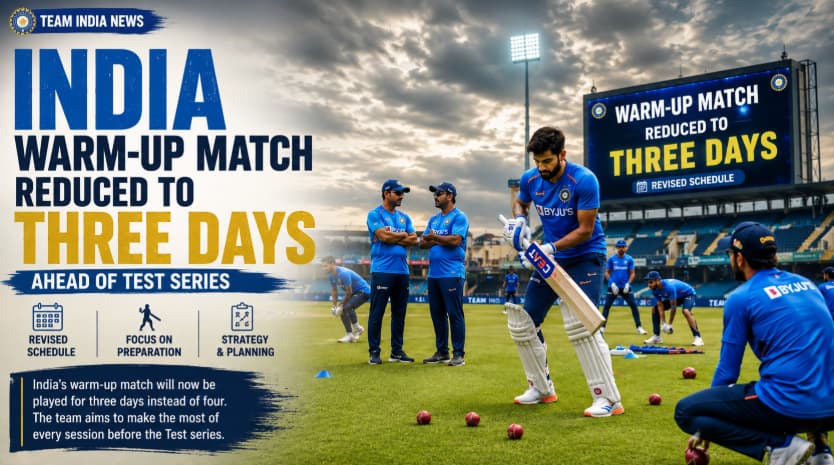
The India Warm-Up Match Reduced to Three Days update has become one of the biggest talking points ahead of India’s upcoming Test assignment. Practice matches are traditionally seen as an important part of overseas tours because they help players adapt to the local conditions, re build match rhythm, and sharpen strategies before the official series gets underway.
But with the latest revision, the decision India Warm-Up Match Reduced to Three Days , basically means India’s scheduled warm-up fixture will only run for three days now, rather than four , which trims the amount of useful match practice the squad can get. Even if this sounds like a small shift, the India Warm-Up Match Reduced to Three Days update could end up having a real impact on who gets selected , how the players workload is managed, and even how the team gears up for the next Test series.
Why Was India’s Warm-Up Match Reduced?
The choice to shorten the fixture, reportedly, comes as part of scheduling adjustments between the participating cricket boards. In recent years, modern international cricket calendars are getting more and more jammed, so administrators try to optimize travel, broadcasting commitments, and player workloads, all at once.
There are a few reasons that may have helped drive the change, including:
A tight international schedule:
- Travel logistics
- Ground availability
- Broadcasting arrangements
- Player workload management
- Preparation for the opening Test
Even though the exact cause can differ depending on the tour arrangements, the revised schedule means India will have fewer overs of competitive cricket before the Test series starts.
Warm-Up Matches in Test Cricket: why they matter
Warm-up games are far more than practice sessions. They help players experience real match situations without the pressure that comes with official international competition.
Some of the bigger advantages include:
- Getting used to Pitch conditions
- Learning the pace off the surface
- Hitting rhythm with new bowlers
- Finalizing field placements under game pressure
Every country has its own playing vibe. Batters need time, to feel the bounce and the movement, while bowlers learn how a pitch behaves during the day.
Improving match fitness
Even if players do plenty of training, match situations cannot be recreated fully in nets
Finalizing team combination
Coaches also rely on warm up fixtures to work out, how to set up the side
- Opening combination
- Middle order batting
- Bowling attack
- Wicketkeeper selection
- Spin versus pace balance
Building confidence
Scoring runs or grabbing wickets before the Test series begins helps players grow more confident
How the three day format changes preparation
Since one day is removed, the management has less time to judge players, and decide who fits where
Key challenges include:
Limited batting opportunities
Not every batter will get enough time in the middle
Reduced bowling workload
Fast bowlers usually build rhythm little by little. With a shorter match there are fewer overs
Less experimentation
The coaching staff might avoid trying a few different setups because there is limited playing time, and that can make decisions feel a bit more locked in.
India Warm-Up Match Reduced to Three Days: Impact on India’s Batters
Most batters would rather spend long hours standing at the crease before a Test series really begins.
The top-order group will likely concentrate on:
Letting some balls go outside off stump
- Playing late in the innings
- Rotating the strike
- Building extended partnerships
- Adjusting to movement off the pitch, like swing and seam
The middle-order batters will prepare themselves for multiple match scenarios, while the lower-order batters will focus more on staying in and supporting the partnership.
Fast Bowlers Face a Different Challenge
India has one of the most formidable pace attacks in world cricket.
With a shorter set of matches, the bowlers could end up with fewer chances to:
- Deliver long spells
- Work on reverse swing in Tests
- Develop endurance over time
- Try varying lengths
- Practice specific field settings
Because of that, the coaching staff may lean on extra net sessions to make up for the reduced workload.
India Warm-Up Match Reduced to Three Days: Opportunity for Spin Bowlers
Although fast bowlers often get more attention before overseas Tests, spin bowlers also gain from competitive reps.
A three day game still gives chances to:
- Test different lengths
- Hit into attacking fields
- Build steadiness
- Tune pace variations
India Warm-Up Match Reduced to Three Days: Role of the coaching staff
Modern coaching runs well past straight technical work.
The support group will watch closely:
- Player workload
- Recovery sessions
- Fitness metrics
- Bowling intensity
- Batting output
- Fielding standards
Technology, video review, and performance tracking will help make the most of the shorter preparation window.
Can net sessions replace match practice?

Net sessions matter, but they cannot fully stand in for real competition.
In a match, players have to handle:
- Scoreboard pressure, fatigue
- Tactical field placements
- Bowling changes
- Session management
These things are hard to reproduce in the usual practice setting.
Positives of a shorter warm up match
Even with the doubts, there are real advantages
Better Workload Management
Fast bowlers can avoid unneeded fatigue, and keep the body calmer.
Reduced Injury Risk
If teams bowl fewer overs it can mean less physical strain.
Fresh Players
The squad walks into the opening Test with fresher legs, and a slightly cleaner rhythm.
More Tactical Meetings
With extra time on the clock, the staff gets more hours for planning, and analysis too.
Challenges Team India Must Overcome
India now has to get the maximum out of every session that’s available.
Key areas of attention include:
- Efficient batting practice, calm shot selection
- Bowling discipline, consistent lines
- Slip catching, quicker reactions
- Fielding drills, sure hands
- Running between wickets, sharper decisions
- Fitness management, proper workload control
India Warm-Up Match Reduced to Three Days: What Fans Can Expect
Even with a shorter match, it still feels very important.
Fans can look out for:
- The opening batting pair
- Bowling combinations
- Player fitness levels
- Fresh tactical plans
- Rising youngsters
- How the senior stars perform
These signals typically point toward India’s most likely playing XI.
Preparation Beyond the Warm-Up Match
The coaching group is expected to organize:
- Longer net sessions
- Work against local bowlers
- Practice built around specific match scenarios
- Fielding competitions,
- Bowling workload management
- Video analysis meetings
These kinds of things keeps players fully ready even if there are fewer match days, more or less.
Looking Ahead to the Test Series
India enters the Test series with high expectations. While the India Warm-Up Match Reduced to Three Days decision shifts the preparation schedule, it does not always weaken India’s chances.
Modern teams depend on sports science, data insights, and a more structured training approach. That work, helps compensate for the reduced amount of match time. Also, seasoned players can be quite flexible when the fixtures change, quickly.
If India’s batters get settled early, the bowlers find their rhythm. Then the side carries out its plans well, and the shortened warm up fixture might become a small aside, not a decisive problem.
Conclusion
The news that the India Warm-Up Match Reduced to Three Days has sparked discussions among cricket experts and fans alike, and you can already hear the usual opinions flying around a lot faster than the ball. Warm-up matches play a vital part in preparing for challenging Test series, giving players a chance to adapt to local conditions and sharpen their skills in real match rhythms. Yet the revised timetable also trims valuable playing time, so the whole thing feels a bit tighter. Even so, India’s seasoned squad and well organized support staff have the tools to make every session count, and squeeze the most out of it.
In the end, success in the Test series will hinge on execution, adaptability, and consistency, not the length of a single practice game. Cricket fans can now watch closely as Team India responds to this shift and whether the shorter preparation, yes, even with less time, turns out enough before the crucial Tests.